Note: This page is not an official CBSE document. Follow your teacher’s instructions and your school’s practical file format. This is an independent, free tool. It is not affiliated with, endorsed by or operated by the Sports Authority of India, Khelo India or the Fit India Mission.
All ages
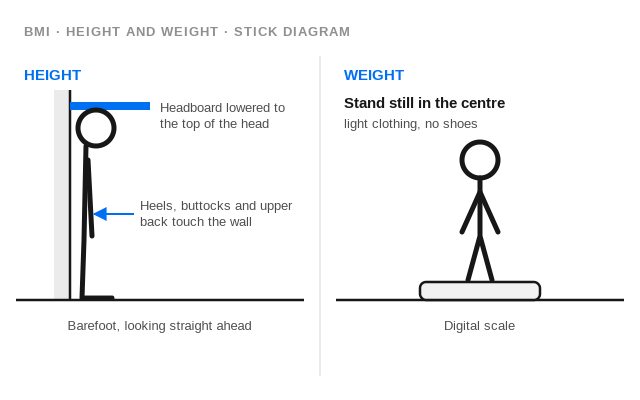
BMI for Children stick diagram
Measures: BMI for children is a quick screen of body composition: weight relative to height. Because children grow, the same BMI means different things at different ages, so the result is read against the norms for the child’s age and gender rather than a single adult cutoff.
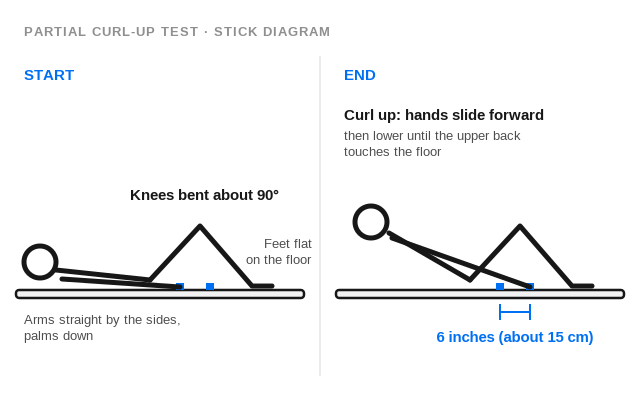
Measures: The partial curl up test measures the strength and endurance of the abdominal (stomach) muscles. A curl-up only counts when the hands slide the full 6 inches and the upper back returns to the floor.
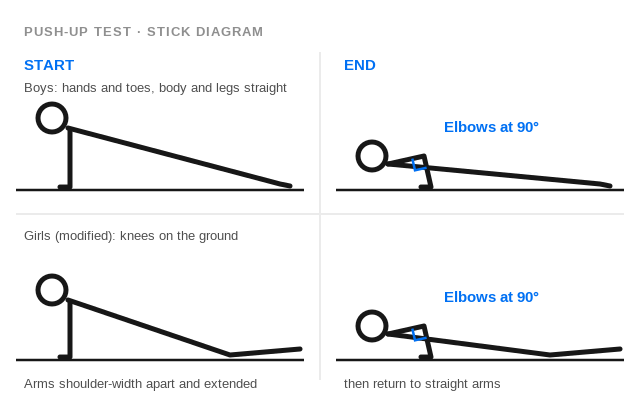
Measures: The push up test measures the strength and endurance of the arms, shoulders and chest. Only push-ups with a straight body and elbows bent to 90° are counted.
Start
Boys: hands and toes on the floor, body and legs straight
Girls (modified): the same, with the knees on the ground
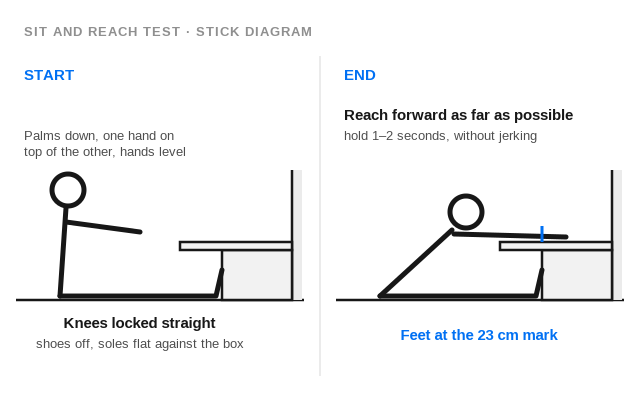
Measures: The sit and reach test measures flexibility — mainly of the lower back and the hamstrings (the muscles at the back of the thigh). It is the flexibility test in the Fit India battery.
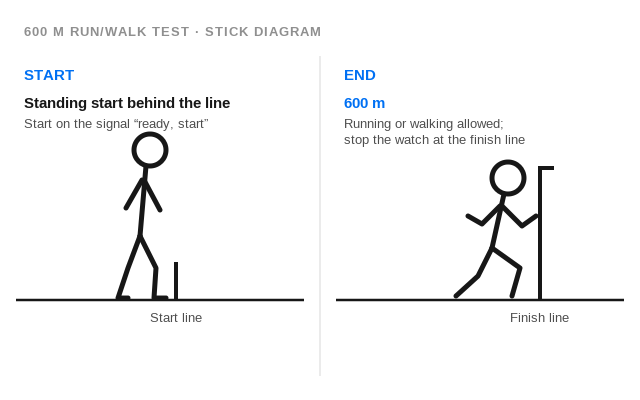
Measures: The 600 meter run test measures cardiovascular (aerobic) endurance — how well the heart and lungs keep the body going over a longer effort. Walking is allowed, but a faster time is a better score.
Start
Standing start behind the line
Start on the signal “ready, start”
End
Cover 600 m; walking is allowed
The watch stops as the student crosses the finish line
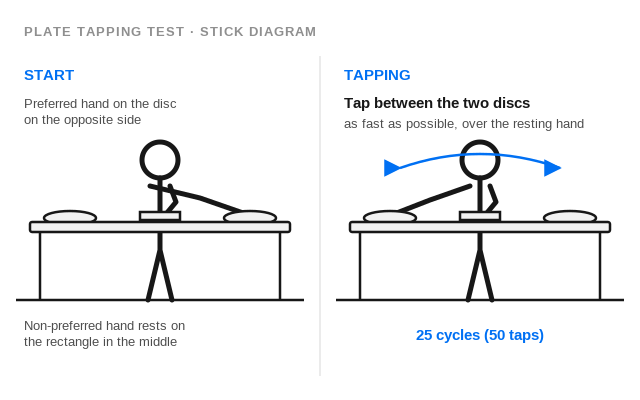
Measures: The plate tapping test measures how quickly a child can move one hand back and forth between two targets while the other hand stays still. It reflects speed of limb movement and hand–eye coordination.
Start
Non-preferred hand rests on the rectangle
Preferred hand on the disc on the opposite side
Tapping
Tap back and forth between the two discs, over the resting hand
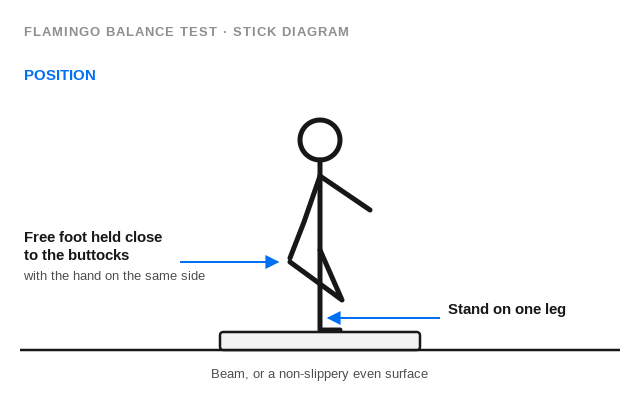
Measures: The flamingo balance test measures static balance: how well a child can hold a still position on one leg. The fewer times the child loses balance in 60 seconds, the better the score.
Position
Stand on one leg
Free foot held close to the buttocks with the hand on the same side
Which stick diagrams do I need for the Class 11 and 12 PE practical?
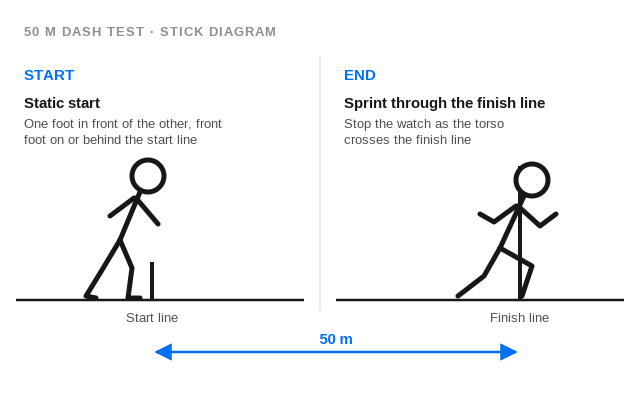
Class 11 and 12 students are in the 9–18 years group, so the tests are BMI, Partial Curl-up, Push-ups (modified push-ups for girls), Sit and Reach, 600 m Run/Walk and 50 m Dash. Your teacher may also ask for the age 5–8 tests (Plate Tapping and Flamingo Balance) when you describe the whole battery.
Can I copy these diagrams into my practical file?
Yes. They are original illustrations drawn to be easy to copy by hand. Redraw them in your own file and follow your teacher’s instructions and your school’s format.
How do I print or save the diagrams?
Press “Print all diagrams” to print every diagram large on plain pages, or use the SVG and PNG download links under each diagram to save one.
Is this the official SAI or Khelo India website?
This is an independent, free tool. It is not affiliated with, endorsed by or operated by the Sports Authority of India, Khelo India or the Fit India Mission.