Simple, safe activities for students and PE teachers, one section for each test in the Fit India (SAI Khelo India) fitness test. The activities come from the official Fit India protocol.
Note: This is a practical guide, not an official SAI, Khelo India or Fit India document. The activities are taken from the official Fit India, “Fitness Protocols and Guidelines for Age 5–18 Years”. This is an independent, free tool. It is not affiliated with, endorsed by or operated by the Sports Authority of India, Khelo India or the Fit India Mission.
How to improve, in short
Be active every day. Play, games, sport and dance all count.
Pick your weakest test and practise its activities below regularly.
Learn the correct form for each test. Only correct curl-ups and push-ups are counted.
Warm up before and cool down after, and stop if anything hurts.
Test again at the end of the year and compare the results.
Activities to improve each test
Each test below shows what it measures and simple activities to practise. Open the test for the full procedure and norms, or the stick diagram for a simple drawing.
All ages (5–18): BMI and healthy habits
How to improve BMI: healthy habits
Age 5–18
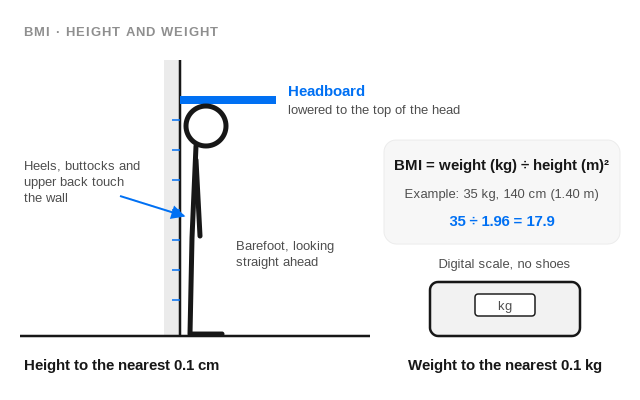
What it measures: BMI for children is a quick screen of body composition: weight relative to height. Because children grow, the same BMI means different things at different ages, so the result is read against the norms for the child’s age and gender rather than a single adult cutoff.
Be active every day: Play, sports, dance, cycling, running games. As a general guide, the protocol suggests at least 60 minutes a day of moderate-to-vigorous activity on average across the week, mostly aerobic.
Play hard and build strength: Fast games and activities that strengthen muscles and bones, such as climbing, jumping and skipping, on at least 3 days a week (a general guide).
Sleep and rest well: Good-quality sleep and enough rest help the body recover from activity.
Eat regular, balanced meals and drink water: Regular home meals and enough water, especially on active and hot days.
Sit less: Break up long periods of sitting, and keep time on phones, TV and games for fun in check.
BMI is a health screen, not a target. Children are still growing, so focus on healthy habits, not on weight. No dieting or calorie counting. If you are worried about a child’s growth or weight, talk to a doctor.
Source: Fit India, “Fitness Protocols and Guidelines for Age 5–18 Years”, pages 14, 29 and 47; screen time from the WHO Guidelines on Physical Activity and Sedentary Behaviour (2020), which the protocol cites.
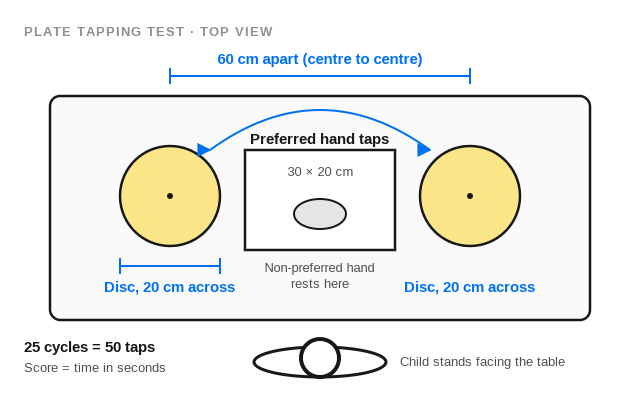
What it measures: The plate tapping test measures how quickly a child can move one hand back and forth between two targets while the other hand stays still. It reflects speed of limb movement and hand–eye coordination.
Paper airplane throw: Fold a paper plane and throw it at a target.
Handkerchief catch: Drop or toss a handkerchief and catch it before it lands.
Frisbee: Throw and catch a frisbee with a partner.
Ruler drop: A partner lets go of a ruler and the child catches it as quickly as possible.
Throwing and catching: Throw a soft ball to a partner and catch it back.
Source: Fit India, “Fitness Protocols and Guidelines for Age 5–18 Years”, page 20; throwing and catching from page 33 (Activity 7, age 5–8).
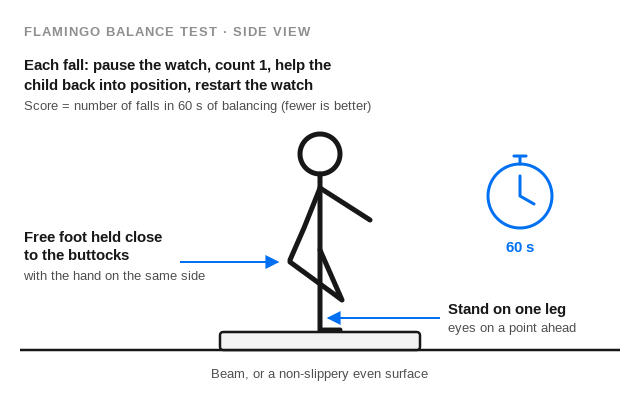
What it measures: The flamingo balance test measures static balance: how well a child can hold a still position on one leg. The fewer times the child loses balance in 60 seconds, the better the score.
One-foot balance: Stand on one leg like a stork, eyes fixed on a point ahead, then change legs.
Heel-toe walking: Walk with the heel of one foot just in front of the toes of the other.
Walking on a straight line: Walk along a line drawn on the floor or ground.
Hopping: Hop on one foot, then the other. Skipping helps too.
Vrikshasana: The tree pose: stand on one leg with the other foot resting on the inner leg.
Source: Fit India, “Fitness Protocols and Guidelines for Age 5–18 Years”, page 21.
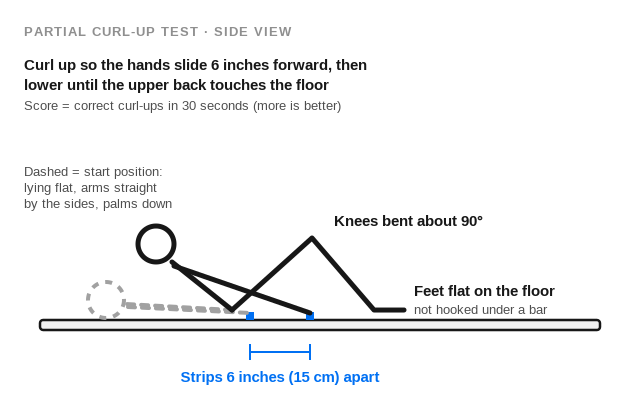
What it measures: The partial curl up test measures the strength and endurance of the abdominal (stomach) muscles. A curl-up only counts when the hands slide the full 6 inches and the upper back returns to the floor.
Planks: Hold the body in a straight line on the forearms and toes.
Crunches: Lie on the back, knees bent, and curl the shoulders up slowly, then lower slowly.
Naukasana: The boat pose: balance on the hips with the legs and upper body raised.
Shalabhasana: The locust pose: lie on the stomach and lift the legs, for the back muscles.
Climbing stairs: Walk up stairs at a steady pace.
Source: Fit India, “Fitness Protocols and Guidelines for Age 5–18 Years”, pages 22 and 24.
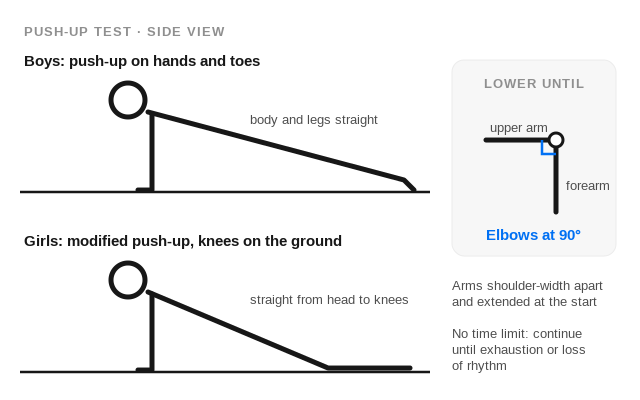
What it measures: The push up test measures the strength and endurance of the arms, shoulders and chest. Only push-ups with a straight body and elbows bent to 90° are counted.
Wall push-ups: Hands on a wall at shoulder level, body straight; bend the arms to bring the chest to the wall and push back. A good first step.
Push-ups: Practise with a straight body, from the knees (as girls do in the test) or from the toes.
Planks: Hold the body in a straight line on the forearms and toes.
Squats: Feet flat, bend the knees and lower in a controlled way, then stand up.
Climbing stairs: Walk up stairs or a hill at a steady pace.
Source: Fit India, “Fitness Protocols and Guidelines for Age 5–18 Years”, pages 22 and 24; wall push-ups from page 40 (strength activities, age 9–14).
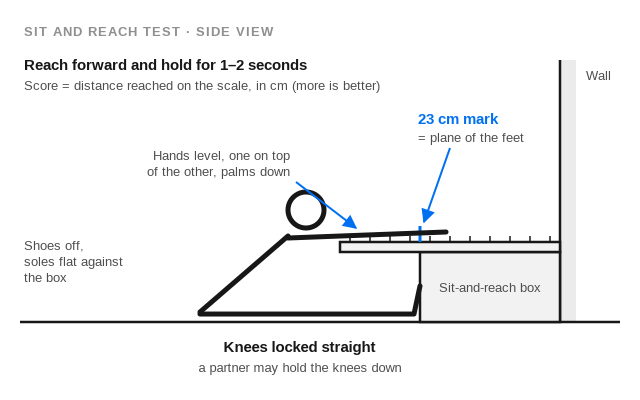
What it measures: The sit and reach test measures flexibility — mainly of the lower back and the hamstrings (the muscles at the back of the thigh). It is the flexibility test in the Fit India battery.
Toe touching: Reach gently towards the toes with the knees straight. No bouncing.
Paschimottanasana: The seated forward bend: sit with legs straight and reach forward slowly.
Trikonasana: The triangle pose: feet apart, bend sideways to reach one hand down the leg.
Knee to chest stretch: Lie on the back and pull one knee towards the chest, then the other.
Forward bend: Stand and bend forward from the hips, keeping the neck and shoulders relaxed.
Stretch slowly and only until a gentle pull is felt. The protocol advises children to avoid extreme forward and backward bends.
Source: Fit India, “Fitness Protocols and Guidelines for Age 5–18 Years”, page 26; knee to chest from page 41 (flexibility activities, age 9–14); forward bend from page 44 (flexibility activities, age 15–18).
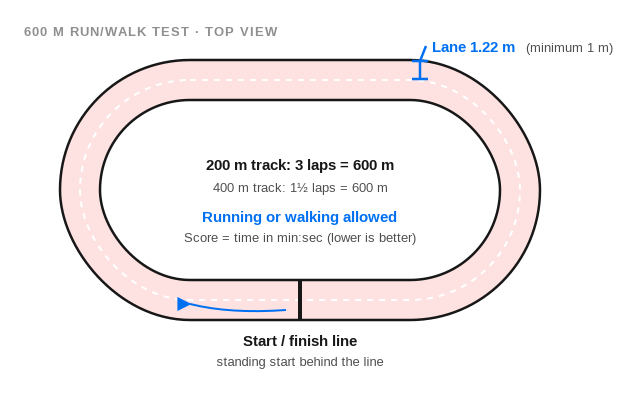
What it measures: The 600 meter run test measures cardiovascular (aerobic) endurance — how well the heart and lungs keep the body going over a longer effort. Walking is allowed, but a faster time is a better score.
Running: Run at a steady, even pace you can keep going. The protocol stresses learning to pace the run.
Brisk walking: Walk a little at first, then slowly walk for longer.
Cycling: Ride a bicycle where it is safe to do so.
Swimming: Only where there is a trained adult or lifeguard.
Dancing: Dance or aerobics to music.
The protocol also lists pranayama (breathing practice). Learn it from a trained yoga teacher.
Source: Fit India, “Fitness Protocols and Guidelines for Age 5–18 Years”, page 27; brisk walking from page 42 (endurance activities, age 15–18).
Warm up first: light movement and gentle stretching. The protocol suggests about 5–10 minutes (a general guide).
Cool down afterwards with light activity and stretching, again about 5–10 minutes.
Drink water, and avoid long, hard exercise in hot and humid weather.
Stop at once if there is pain, dizziness or the student feels unwell, and get medical help.
A child with a known health condition should exercise under supervision, after a doctor says it is safe.
Start gently and build up slowly, especially if the student is new to exercise.
Keep it age-appropriate: no weights or heavy equipment for young children, and yoga or pranayama only with a trained teacher.
Source: Fit India, “Fitness Protocols and Guidelines for Age 5–18 Years”, Guidelines and Safety Considerations. This is an independent, free tool. It is not affiliated with, endorsed by or operated by the Sports Authority of India, Khelo India or the Fit India Mission.
How can a student improve their fitness test score?
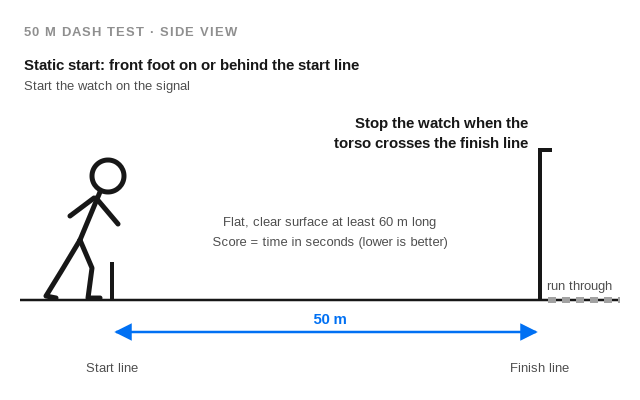
Be active every day and practise the activities for each test regularly: balance games for the flamingo test, catching games for plate tapping, core and arm strength for curl-ups and push-ups, stretching for sit and reach, steady running for 600 m and short sprints for the 50 m dash. Learn the correct form for each test too, because only correct curl-ups and push-ups are counted.
How long does it take to improve?
It is different for every student, and the Fit India protocol does not give a time. Practise regularly, then test again at the end of the year and compare the two results on the progress page.
Should a child diet to improve their BMI?
No. Children are still growing. Focus on healthy habits: daily activity, good sleep, regular balanced meals and less sitting. If you are worried about a child’s weight or growth, talk to a doctor.
Are these activities safe for young children?
They are simple, low-risk activities from the Fit India protocol, and none needs weights. Young children (age 5–8) learn best through play and games. Always warm up, supervise children, and stop if anything hurts.
Is this an official SAI or Fit India page?
No. The activities come from the Fit India protocol, but this page is not an official document. This is an independent, free tool. It is not affiliated with, endorsed by or operated by the Sports Authority of India, Khelo India or the Fit India Mission.